
Recycling Plastic in Asia’s Largest Slum, Dharavi, India
© 2010 Rupal Shah
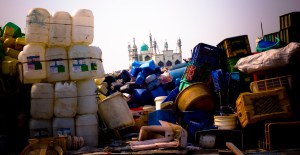
I stood on the roof-top of one of the plastic recycling units in the ’13th compound’ situated in Asia’s largest urban slum, Dharavi (Mumbai, India). Coloured plastic units heaped in a disorderly fashion, flanked by a mosque in the backdrop caught my eye! Plastic materials from Indian households and commercial buildings and electronic devices such as computers and refrigerators from the US and China, are initially sorted according to colour and quality and then melted into tiny plastic pellets.
Distant Dreams – A Rohingya Girl, northern Rakhine State, Myanmar
© 2015 Rupal Shah
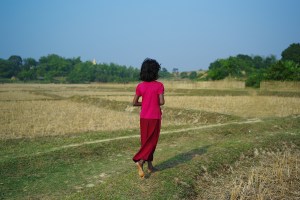
On a recent field visit to a remote village in Maungdaw, northern Rakhine State, a young Muslim girl came darting across the barren field bare-foot to hand back my camera bag, which I had left behind in the household compound. Tragically, playing barefoot and often naked is the norm for children living in Maungdaw. Following the multi-faceted inter-communal violence in 2012, the Rakhine state government imposed severe restrictions on the Muslim rohingya population, limiting their movement and access to local markets, health, and education. Many people have migrated abroad, notably to India, Malaysia, Saudi Arabia, and United Arabs Emirates, to escape the serious state repression. Muslim people are “voting with their feet” and making the long, arduous, and often costly journey to Bangladesh to seek health care.
On a positive note, there is optimism and indications that these restrictions will ease in the wake of the recent general election results, a subsequent change of government in March 2016, and a gradual democratization process is expected to bring about positive changes for the disenfranchised population.
Live Birth, Rural Karnataka, South India
© 2010 Rupal Shah
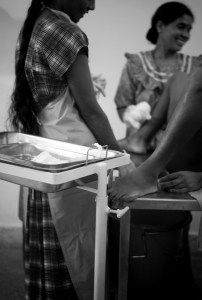
The basic delivery room was filled with laughter, screams, and commotion, as a tribal woman gave birth in a rural primary healthcare centre (basic functional unit for primary health within India’s healthcare system) managed by Karuna Trust, a pioneering rural development organisation in South India. The image shows an auxiliary nurse mid-wife (ANM) and her assistant encouraging the mother to push harder with every contraction. Within 40 minutes the tribal woman gave birth to a healthy baby boy. Karuna Trust has adopted a multi sectoral approach to the management of its primary healthcare centres, with the availability of a 24-hour maternity service and residential health care staff providing access to essential obstetric and new born care.
Bride Burning, Rural Maharashtra, India

© 2011 Rupal Shah
Reshma was admitted to a rural hospital in Maharashtra over one year ago, with 65% burns on her body including chest, back, limbs and face. The 23 year-old, mother of three is a member of the Pardhi tribe, a community that has long been ostracised by mainstream Indian culture. The details surrounding her incident are unclear, though it is suspected that it is a dowry-related burning. Due to the uncertainty surrounding her story and social limitations, no charges against the perpetrators were ever filed.
Since the Pardhi tribe migrated from Gujarat to Maharashtra, Reshma was able to speak a dialect of Gujarati, my Mother tongue and therefore I was able to communicate with her and her family. Over the course of our interaction, I grew to admire her physical and mental resilience and her commitment to educate her children. However, her husband has since abandoned her, taken her children away and remarried. In my eyes, she is still a woman of hope and I pray for her future.
 Rupal Shah Photography